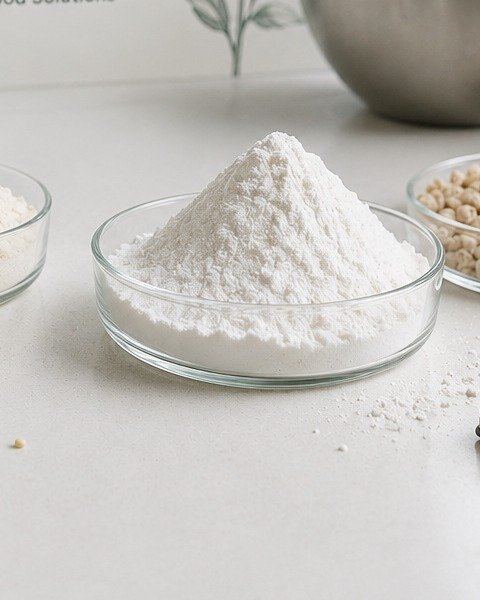
Queens Quinoa makes a native quinoa starch from quinoa grown in Rajasthan. It is separated from the grain by dry fractionation, with no chemical modification. Its granules measure about 1–2 µm, much finer than corn starch at 10–20 µm.
Quinoa starch is in trials with food manufacturers. Samples and pilot-scale quantities are available now; larger volumes are confirmed in writing.
For food manufacturers • personal-care brands • contract manufacturers • importers
Quinoa starch is the starch-rich part of the quinoa grain. We separate it by dry fractionation, alongside our Quinoa Protein Concentrate. Nothing is added and nothing is chemically modified. The intended ingredient declaration is "quinoa starch", subject to local regulatory requirements.

Quinoa starch is new to most formulators. These are the properties that set it apart.
About 1–2 µm in our material. Research reports quinoa starch granules of 0.4–2.0 µm, much smaller than most starches.[1] Small, uniform granules give a smooth texture and mouthfeel[2], and research describes a creamy texture with fat-like properties.[3]
Research reports quinoa starch at about 9–11% amylose, against about 23% for maize and 18% for potato starch, with good resistance to retrogradation.[3] In quinoa lines, retrogradation tendency rises with amylose content.[4]
Research reports excellent freeze-thaw stability for quinoa starch, which suits frozen products.[3] Our own testing showed low water separation through freeze-thaw.
Many food starches are chemically modified to stop water separating out over time.[5] Ours is native; the intended declaration is "quinoa starch", subject to local regulatory requirements. It is not a one-for-one replacement for modified starch in every application.
Our starch carries about 10–11% protein from the grain (current technical data), so it adds a mild protein contribution alongside thickening.
Intact quinoa starch granules have been used in research to stabilise emulsions as particles (Pickering emulsions), with applications suggested beyond food, in cosmetics and pharmaceuticals.[6]
Findings marked [n] come from published research on quinoa in general (see Research notes), not from tests on Queens Quinoa product. Confirm every application in your own trials.
| Industry | What to evaluate it for | Why it may fit |
|---|---|---|
| Frozen and ready meals | Sauces and gravies that hold their water after freezing and reheating | Low amylose and freeze-thaw stability in research[3]; low water separation in our testing |
| Dairy and dairy alternatives | Yogurt, ice cream, desserts and dairy drinks with a smooth, creamy body | Small granules and a fat-like texture[2][3] |
| Soups, sauces and dressings | Smooth texture and emulsion stability | Fine particles studied as emulsion stabilisers[6] |
| Bakery | Fillings, creams and glazes that stay smooth | Smooth texture from small granules[2]; start at your current starch level |
| Confectionery | Gummies and soft confectionery | Starting point 5–15% for bench trials |
| Personal care and cosmetics | Talc-free powders; emulsions | The fine particle size makes quinoa starch worth evaluating in talc-free powder systems; particle-stabilised emulsions in research[6] |
| Quinoa starch | Corn (maize) starch | Potato starch | |
|---|---|---|---|
| Granule size | About 1–2 µm (ours); 0.4–2.0 µm in research[1] | 10–20 µm | 20–100 µm |
| Amylose (research) | About 9–11%[3] | About 23%[3] | About 18%[3] |
| Retrogradation | Good resistance in research[3] | Higher amylose generally means a higher tendency[4] | Higher amylose generally means a higher tendency[4] |
| Texture | Smooth, creamy, fat-like[2][3] | Depends on grade | Depends on grade |
| Ours: processing | Native; no chemical modification | Often chemically modified for stability[5] | Often chemically modified for stability[5] |
Quinoa starch properties vary by variety: one study of eight quinoa lines found amylose from 3% to 20%.[4] Our technical data sheet gives the values for our material.
Choose on application fit and trial data, not on the assumption that one starch wins in every system.
A 1 kg sample with the technical data sheet and allergen declaration, shipped within 5 working days.
| Product | Native quinoa starch |
|---|---|
| Process | Dry fractionation of quinoa, alongside our protein concentrate. No chemical modification |
| Source | Quinoa grown in Rajasthan through our quinoa supply network |
| Protein | About 10–11%, carried from the grain (current technical data) |
| Granule size | About 1–2 µm (corn starch: 10–20 µm; potato starch: 20–100 µm) |
| Gelatinisation | About 55–70°C in our testing |
| Freeze-thaw | Low water separation in our freeze-thaw testing |
| Preparation | Cold slurry at 1:4 with water, then heat to 70–80°C while stirring |
| Declaration | Intended as "quinoa starch", subject to local regulatory requirements |
| Samples | 1 kg, shipped within 5 working days of address confirmation |
| Volumes | Pilot-scale quantities available; volumes confirmed in writing |
Starting points for bench trials, not validated formulations. Every product needs its own testing. For personal care, the fine particle size makes quinoa starch worth evaluating in talc-free powder systems.
Granule size, gelatinisation, preparation and storage guidance.
Based on the raw material, process controls and available test results.
1 kg, shipped within 5 working days of address confirmation.
Standard technical and export documentation; destination requirements confirmed before shipment.
It is the starch-rich part of the quinoa grain. Queens Quinoa produces it by dry fractionation, alongside our Quinoa Protein Concentrate, from quinoa grown in Rajasthan.
No. It is a native quinoa starch without chemical modification. The intended ingredient declaration is "quinoa starch", subject to local regulatory requirements.
About 1–2 µm. That is much finer than corn starch (10–20 µm) or potato starch (20–100 µm).
Yes. Our quinoa starch carries about 10–11% protein from the grain, per our current technical data, so it adds a mild protein contribution alongside thickening.
It showed low water separation through our freeze-thaw testing. Confirm it in your own product, because results depend on the formulation.
At about 55–70°C in our testing.
Hydrate it as a cold slurry (1 part starch to 4 parts water), then heat to 70–80°C while stirring.
Frozen and ready meals, soups and sauces, yogurt, ice cream and dairy drinks, gummies and bakery. Starting points for bench trials are listed on this page; they are not validated formulations.
The fine particle size makes quinoa starch worth evaluating in talc-free powder systems, such as face powders, dry shampoo and body powders.
It is in trials with food manufacturers. Samples and pilot-scale quantities are available now, and larger volumes are confirmed in writing before any launch commitment.
Request one through our contact page. Samples (1 kg) ship within 5 working days of your delivery address being confirmed, with the technical data sheet and allergen declaration.
Queens Quinoa Pvt Ltd of Udaipur, India, which has worked with quinoa in Rajasthan since 2014. The same process produces our Quinoa Protein Concentrate.
Published research on quinoa starch in general. Our own values are in the technical data sheet.