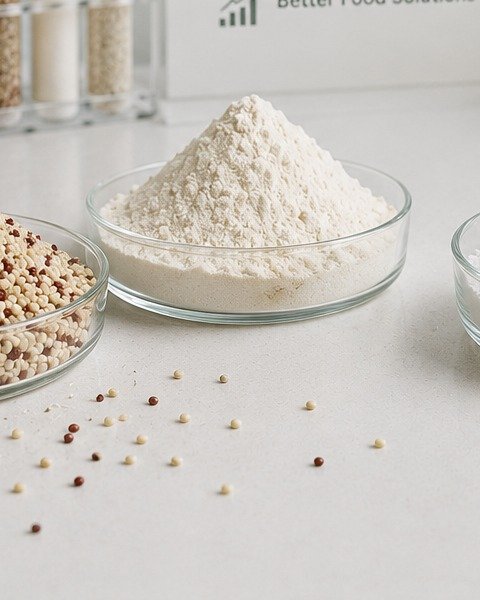
Queens Quinoa makes a Quinoa Protein Concentrate (QPC) from quinoa grown in Rajasthan. It is separated from the grain by dry fractionation, without solvents, and tested at 30.52% protein by a third-party laboratory. It is made for blends, protein-fortified foods and nutrition products.
QPC is in trials with food manufacturers. Samples and pilot-scale quantities are available now; larger volumes are confirmed in writing.
For food, nutrition and nutraceutical brands • contract manufacturers • importers
Quinoa protein concentrate is the protein-rich part of the quinoa grain, separated from the starch by milling and air classification. Queens Quinoa QPC is a concentrate for blends and protein-fortified foods. It is not a one-for-one replacement for a pea, soy or whey isolate. Because quinoa contributes all nine essential amino acids, QPC works well alongside pea, rice or other plant proteins in a blend.

Quinoa protein is new to most formulators. These are the properties that set it apart.
Research reports quinoa protein with lysine comparable to soybean and at least twice that of wheat, maize and rice.[1] Quinoa contributes all nine essential amino acids.
Legumes such as pea tend to be low in methionine and cysteine, while grains tend to be low in lysine.[2] Pea and quinoa blends are studied to balance the amino-acid profile.[3] QPC is made for exactly this kind of blend.
Dry fractionation keeps quinoa protein in its native state; wet extraction is more energy-intensive and can affect protein functionality.[4] Ours is dry-fractionated, without solvents.
Research reports quinoa protein water binding of 2.0–3.9 g per g and oil binding of 1.88–3.32 g per g, with emulsifying, foaming and gelling properties.[5]
As per our current allergen declaration, QPC is free from gluten, soy, dairy, nuts and eggs.
Quinoa is a familiar ingredient on a pack, which helps when a brand wants a recognisable protein source.
Findings marked [n] come from published research on quinoa in general (see Research notes), not from tests on Queens Quinoa product. Confirm every application in your own trials.
| Industry | What to evaluate it for | Why it may fit |
|---|---|---|
| Protein bars and snacks | Raising protein and balancing pea or rice protein | Lysine-rich profile[1]; complements legume protein[2][3]; mild flavour |
| Bakery | Protein-enriched breads, cookies and baked snacks | Water and oil binding in research[5]; stable to 120°C for short processing times (our data) |
| Pasta and noodles | Protein-enriched pasta | Starting point 8–20% for bench trials |
| Plant-based meat | Binding, water holding and texture | Water and oil binding and gelling properties in research[5] |
| Dairy alternatives and beverages | Plant-based yogurts, desserts and protein drinks | Emulsifying properties in research[5]; best at pH 6–8 (our data). Research shows low solubility at acidic pH[5], so test acidic drinks carefully |
| Nutrition and nutraceutical brands | Protein blends and fortified powders | Adds lysine-rich quinoa protein to a blend[1][3] |
| Quinoa protein (QPC) | Pea protein | Soy protein | Rice protein | |
|---|---|---|---|---|
| Amino-acid profile | Lysine-rich[1]; all nine essential amino acids | Low in methionine and cysteine[2] | Low in methionine and cysteine[6] | Low in lysine[2][6] |
| Role in a blend | Complements pea or rice | Often paired with rice[2] | Used alone or in blends | Often paired with pea[2] |
| Declared major allergen | No, as per our allergen declaration | Not a major declared allergen in most markets | Yes, soy is a major declared allergen | Not a major declared allergen in most markets |
| Typical format | Concentrate, 30.52% protein (ours) | Usually sold as a concentrate or isolate | Usually sold as a concentrate or isolate | Usually sold as a concentrate or isolate |
| Processing (ours) | Dry fractionation, no solvents | Varies by supplier | Varies by supplier | Varies by supplier |
QPC is a concentrate for blends and protein-fortified foods, not a one-for-one replacement for a pea, soy or whey isolate. Allergen rules differ by country; check your destination market.
Neither a concentrate nor an isolate is automatically better. The right choice depends on the product brief.
A 500 g sample with the specification sheet, lab report and allergen declaration, shipped within 5 working days.
| Product | Quinoa Protein Concentrate (QPC) |
|---|---|
| Protein | 30.52% (third-party lab test, Lilaba Analytical Laboratories, August 2026) |
| Process | Dry fractionation: cleaning, milling and air classification. No solvents |
| Source | Quinoa grown in Rajasthan through our quinoa supply network |
| Amino acids | Quinoa contributes all nine essential amino acids |
| Allergens | Free from gluten, soy, dairy, nuts and eggs, as per our current allergen declaration |
| Flavour | Mild |
| Processing | Stable to 120°C for short processing times; best at pH 6–8 (current technical data) |
| Samples | 500 g, shipped within 5 working days of address confirmation |
| Volumes | Pilot-scale quantities available; volumes confirmed in writing |
Starting points for bench trials, not validated formulations. Every product needs its own testing.
The same process also produces Queens Quinoa quinoa starch, a native starch without chemical modification.
Composition and quality parameters for the current product.
Handling, processing behaviour and storage guidance.
Lilaba Analytical Laboratories, report LAL-FD-040826038, batch QQ/QPP/0626/01.
Based on the raw material, process controls and available test results.
500 g, shipped within 5 working days of address confirmation.
Standard technical and export documentation; destination requirements confirmed before shipment.
It is the protein-rich part of the quinoa grain, separated from the starch by milling and air classification. Queens Quinoa's Quinoa Protein Concentrate (QPC) is made this way, without solvents, from quinoa grown in Rajasthan.
30.52% protein, measured by a third-party laboratory (Lilaba Analytical Laboratories, report LAL-FD-040826038, batch QQ/QPP/0626/01, August 2026).
No. QPC is a concentrate, made for blends and protein-fortified foods. It is not a one-for-one replacement for a pea, soy or whey isolate. It is often used alongside pea or rice protein.
QPC is in trials with food manufacturers. Samples and pilot-scale quantities are available now, and larger volumes are confirmed in writing before any launch commitment.
Yes. Quinoa contributes all nine essential amino acids, so QPC can complement pea, rice or other plant proteins in a blend.
As per our current allergen declaration, QPC is free from gluten, soy, dairy, nuts and eggs. The declaration is part of the sample pack.
Per our current technical data, QPC is stable to 120°C for short processing times and performs best at pH 6 to 8. It has a mild flavour.
Protein bars and snacks, bakery, pasta, plant-based meat, dairy alternatives and protein blends for nutrition products. Starting points for bench trials are listed on this page; they are not validated formulations.
Request one through our contact page. Samples (500 g) ship within 5 working days of your delivery address being confirmed, with the specification sheet, technical data sheet, lab report and allergen declaration.
Yes. Standard technical and export documentation can be provided, and destination-specific requirements are confirmed before shipment. Pilot-scale quantities are available, with volumes confirmed in writing.
Queens Quinoa Pvt Ltd of Udaipur, India, which has worked with quinoa in Rajasthan since 2014. The same process also produces Queens Quinoa quinoa starch.
Published research on quinoa protein in general. Our own values are in the specification sheet and lab report.